ITOW: Bird Watching
Journalist Keith O’Brien traces the early days that defined Larry Bird’s legendary career
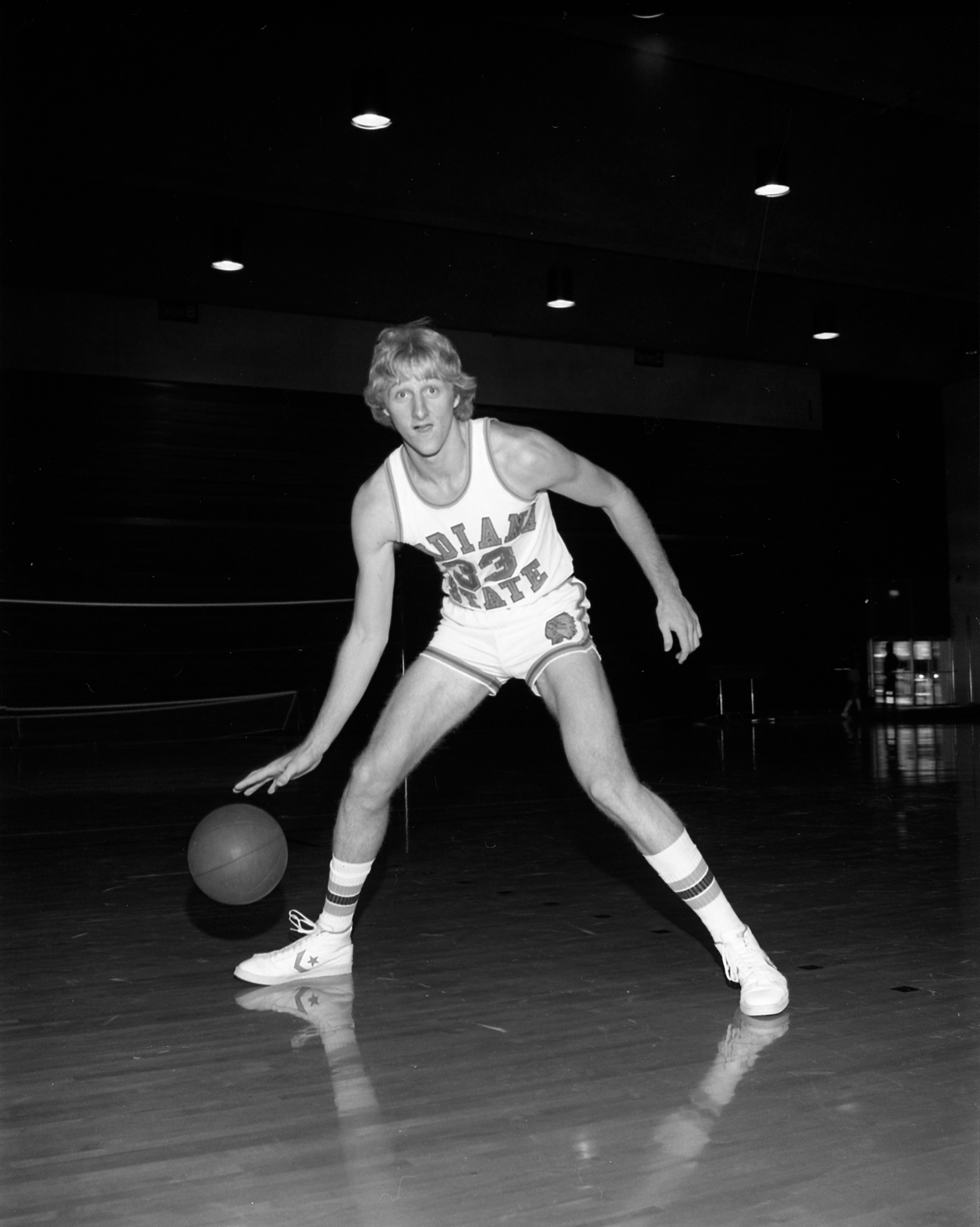
Photo Courtesy Indiana State University Special Collections
Nearly 35 years after basketball legend Larry Bird last walked off the court, his impact on the game hasn’t wavered. His technique is still gawked at, and the NBA’s top competitors still marvel at his tenacity for winning.
After becoming a three-time NBA champion, spending 13 years with the Celtics and racking up countless accolades before being felled by injury, some parts of Bird’s life have remained silent. And Bird doesn’t often talk to the press, much less a journalist seeking to know more about him.
Before he was drafted by the Boston Celtics in 1978, Bird, a virtual unknown outside of basketball circles, was already carrying a lot on his shoulders. Not many foresaw just how comprehensively he would change the game, nor did they see his personal challenges or the pressure he was under. But these early defining moments helped to shape Bird’s legacy.
Durham resident Keith O’Brien has uncovered more about that time than any other journalist, by going to the source — Bird’s hometown of French Lick, Indiana — to talk to those who knew him best. O’Brien talked with New Hampshire Magazine about his book “Heartland: A Forgotten Place, an Impossible Dream, and the Miracle of Larry Bird” and how he got the untold story.
New Hampshire Magazine: Why did you decide to write this book?
Keith O’Brien: I was back in the Midwest (In 2024, O’Brien wrote about the troubled career of Pete Rose in “Charlie Hustle”). I just started thinking about other Midwestern stories that we’ve maybe overlooked. I wasn’t interested in doing a soup to nuts Larry Bird biography. I just thought, is there a way to do it differently.
NHM: But you also knew that Bird was likely not going to speak to you.
O’Brien: Yes and no. I’m a journalist. We go places where we’re not supposed to go. We ask questions we’re not really entitled to ask, right? I’m born and raised in Cincinnati. Working on (“Charlie Hustle”) made me realize that I have a level of expertise about what it was like to grow up in the Midwest in the ’70s and ’80s.
Larry typically doesn’t speak to the media, and he typically and historically has never spoken to an author for a book. At that point, I had built relationships with people who are some of (Bird’s) closest friends. I’ve learned through “Charlie Hustle,” that you can often get a more accurate portrait of a person by talking to 15, 30, 50 people around that person than you can by talking to the person himself.
NHM: The book doesn’t necessarily need Bird’s voice because there are so many other voices that explain him so well.
O’Brien: To be fair to Larry for a second, the media at times in ’78 and ’79, right in the moment where he’s becoming a national star, they do portray him a bit as a country bumpkin. They like to point out that he wears a Carhartt hat. They at times make fun of the way he talks or his grammar. That to me is unfair. Back to my Midwestern roots, it’s not uncommon to see someone wearing a hard hat or overalls, or beat up jeans, or speaking a language that isn’t perfect or grammatically correct.
NHM: It seems like early on, he didn’t have enough support or coaching on how to handle conflict. For example, in February 1979, in a game between the Indiana State Sycamores against the New Mexico State Aggies, he punched a fan in the stands.
O’Brien: A kid like Larry, — really talented, with God-given height, from a poor rural community — even that kind of kid today would have agents and handlers and a
corporate team around him from the age of 15, 16 years old. Larry wouldn’t have gone and enrolled in college when he was 17.
That never happens today.

Author and Durham resident Keith O’Brien. Photo Courtesy/ Keith O’Brien
NHM: There were other, bigger tragedies in Bird’s life. He came across so many different challenges. His father, a war veteran, committed suicide in 1975. That year he quit basketball and worked for French Lick as a garbageman, and yet somehow, he was still able to get drafted by the Celtics.
O’Brien: He’s unbelievable. This is stating the obvious, but he was a historically great player. He probably, in my opinion, is still a top 10 player of all time. In the winter of ’74, ’75, the year that he leaves Bloomington and leaves Bobby Knight and hitchhikes home to French Lick, it totally could have gone in a different direction that winter. Larry was telling people, including maybe most importantly his mother, that he was never going back to college. Larry doesn’t say things for dramatic effect, he doesn’t say things to create a stir. He says what he feels, if he says anything at all. That means that he meant it.
NHM: Another pivotal moment seems to be when his old coach, Bill Hodges, reconnected with Bird, which led him to reconsider a basketball career.
O’Brien: The miracle that really, changes the course of history is this down-on-his-luck assistant coach from Indiana State, Bill Hodges, driving down to French Lick, looking for Larry. And then doesn’t give up on him, and keeps working on him, even after he has a door literally slammed in his face.
NHM: What did you learn about the people of French Lick, Indiana?
O’Brien: I got a sense of the place — it’s 50 years later, of course, but a lot is still the same. It’s still a small town. There remains in French Lick today an awareness of outsiders. I think people are particularly protective of Larry, of this story, because it is their biggest story. Certainly over the years, lots of people have come snooping around on this story, going all the way back to 1978.
NHM: By putting in that extra effort and time, how did it help you write the story?
O’Brien: I think I needed to build up trust with folks, I think I needed to show that I was invested, I think that’s why some people started getting back to me only after I said “I’ll be here next week. If you’re around, I’ll meet you anytime.” I think that mattered to certain folks. And then, once I was on the ground, lots of doors open because you’re there.
NHM: What did you learn about Larry that you didn’t expect?
O’Brien: I think the average sports fan knows that Larry was briefly enrolled at Indiana University, and that he quits and comes home (and starts) hauling trash.
What I didn’t know was just how dark that winter is. He returns to French Lick, and he enrolls in vocational school, and plays on the basketball team there, and then he quits that team, walks away from that school, and then he gets the job with the town. And then amid all that, that’s the winter that his father takes his own life, and that by the spring of the following year he’s really off the map.
You would think that you could go through the newspapers in Indiana, (and) find all these stories about (Bird). No one’s writing those stories. No one cares, even in his own hometown. In the Springs Valley Herald, there are no stories about “what is Larry Bird going to do now.” He’s gone. He really has sort of vanished in a way that I found surprising. So I thought that was stunning.
I think a lot of people know that Larry is an incredibly private person. I think most people know that Larry can also be a prickly person. One thing that surprised me is, some of the things he’s done in the shadows without seeking publicity for some of his teammates — from that 1979 Indiana State team. What he did for Carl Nicks, getting a job with the Pacers. You know what he did for his college roommate, Bob Heaton, after Bob’s family faced a tragedy several years ago. What he did for Jim Jones after he retired in the ’90s, and has sought no publicity for it. I found that to be interesting.
NHM: I liked reading about these seemingly small details that offer insight into Bird’s talent and technique. What do you think made him special?
O’Brien: He was a true competitor, like many greats are. He wanted to win in all scenarios, all the time. And wanted to gut his competition mercilessly, like many of the greats: Michael Jordan, Kobe Bryant, Tiger Woods, Tom Brady, Pete Rose. They all have these same traits, where they want to win in every scenario.
He lived on the basketball court. Growing up, that was one of his only safe places where he felt was a refuge. He lived, he worked on his shot for the act of shooting for the craft of it. He picked up certain tricks and traits, you know, on those playgrounds in French Lick and West Aden that he uses later.
In college and in Indiana, he had this trick where he would …. sort of dip the ball over your head, so you can’t see it, and you feel like he’s passed it. The opponent would typically sort of turn, thinking the ball just passed. Meanwhile, Larry would pull it back and shoot it while you were distracted. That is a trick that, again, based on my reporting, that a social studies teacher named Chuck Akers would do on the outdoor basketball courts in French Lick. Chuck was taller than the kids, and he would hit the ball over their heads, and he’d pass it, and then he would shoot it. And Larry picks up this thing that’s this social studies teacher did at Springs Valley High School, and uses it for the rest of his career.
NHM: Why did you think this part of Larry Bird’s life should be told?
O’Brien: I feel like for the last 50 years, we’ve been telling this story one way. We always tell it as a Bird / Magic story. But it’s a little bit disingenuous, because in the ’70s, these two guys don’t know each other. They’ve met one time. They’ve hardly spoken. They’re not friends, they’re not rivals, they’re not anything.
I just think it’s a bit of a false narrative, and you lose what, to me, is one of the great underdog stories of all time, and you lose the entirety of the Indiana State story. I think honestly the reason why it probably wasn’t told like this before is because people couldn’t figure out how to do it. Indiana State doesn’t win in 1979, so it feels like, “well, that must be sad,” and I don’t think that’s the case. If Indiana State had won in 1979, we’d have been telling this story forever. But because they come up just short, we’ve felt compelled to do Bird Magic / Bird Magic.